Cabo's Building Code Doesn't Guarantee Hurricane Protection. Here's What Buyers Need to Check
Hurricane Odile reached Category 4 strength before making landfall near Los Cabos in 2014 as a major Category 3 storm. More than a decade later, buyers still shouldn't assume "built to code" means a home has impact-rated glass, hurricane shutters, reinforced roof connections, or a real storm-protection plan.
Most buyers assume that if a home is built to code in a hurricane-prone destination, it's built to withstand hurricanes. In Los Cabos, that assumption doesn't hold, and it's worth understanding exactly why before you're deep into a purchase, not after the next storm.
What Actually Happened After Odile
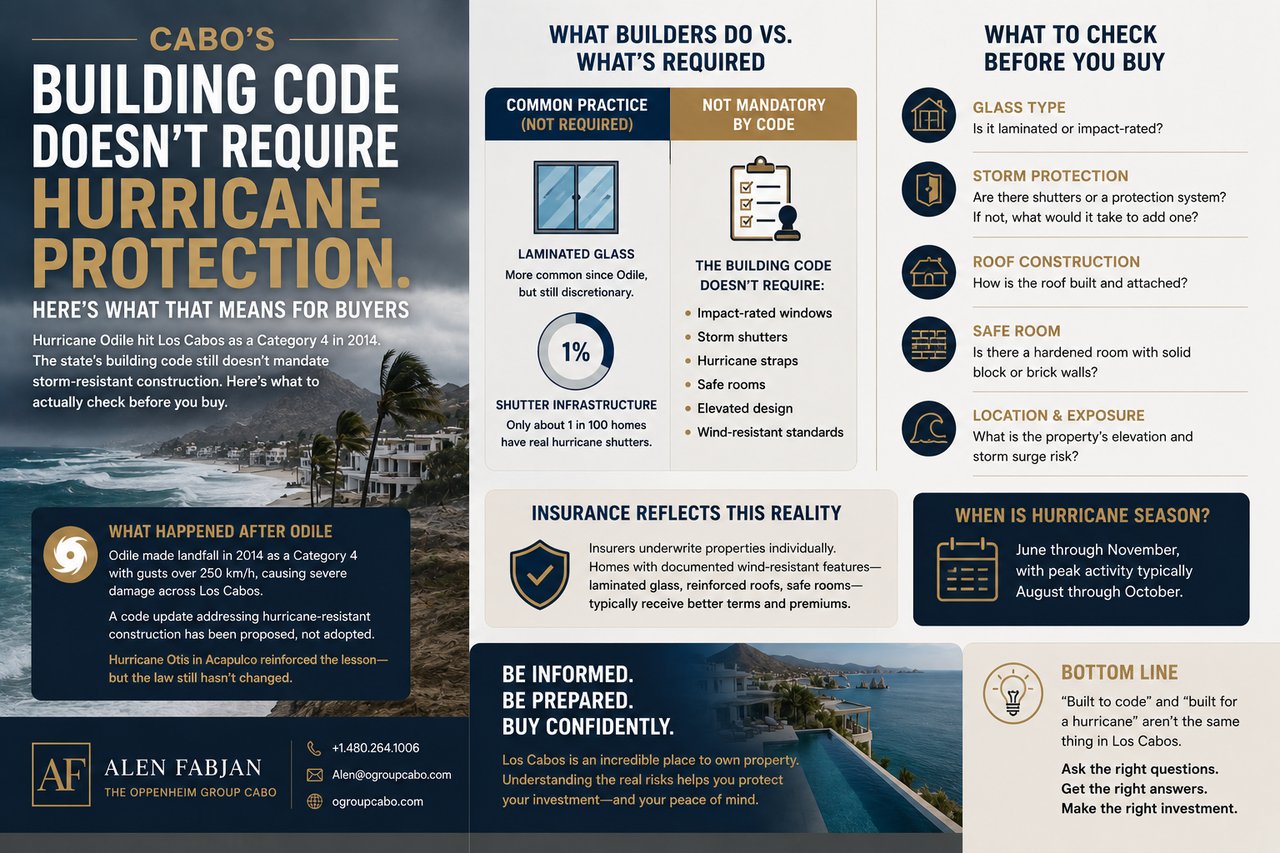
Odile reached Category 4 strength offshore before weakening and making landfall near Cabo San Lucas as a major Category 3 hurricane, with sustained winds of 125 mph (205 km/h) and gusts near 117 mph (188 km/h) recorded at Cabo San Lucas, higher further north. It caused severe, widespread structural damage across the region regardless of the exact category label, and remains tied as the strongest hurricane on record to make landfall on the Baja California peninsula. Here's the part that should stop you: Baja California Sur's construction code wasn't written after Odile and left incomplete. It predates Odile entirely. The current Reglamento de Construcciones para el Estado de Baja California Sur was published in April 2005, nine years before the storm, and as of the most recent government-hosted copy I could find, dated June 2025, it's still that same 2005 version. (certain — pulled directly from a current municipal government filing) A sitting state legislator was still publicly pressing for an update as of her most recent statement on record, specifically noting the code hadn't been revised in eighteen years. Regional architects' and civil engineers' associations have separately gone on record calling for mandatory hurricane and seismic design standards. I could not verify any adopted BCS rule that specifically requires residential hurricane-hardening measures, such as impact-rated glazing, hurricane shutters, or dedicated safe rooms, across Los Cabos. That's a narrower claim than "the code doesn't require hurricane protection" in absolute terms, since general structural design standards may still exist; it's the specific hardening features that I can't confirm are mandated.
What Builders Actually Do vs. What's Required
Here's the nuance that matters for a buyer: some hurricane-resistant practices have become common anyway, just not because the code demands them. Laminated glass, which adds impact and wind resistance over standard glazing, became more common in Cabo construction after Odile as builder-driven best practice. But it's discretionary, not mandatory, which means it varies enormously property to property. Dedicated hurricane shutter systems, in particular, are still far from standard in Los Cabos, even on higher-end homes. The vast majority of homes here, including plenty of expensive ones, were never built with real storm hardening as a designed-in feature.
This isn't a reason to avoid buying in Los Cabos. It's a reason to stop assuming "built to code" answers the storm question, because in this market, it doesn't. It also isn't a dead end if a property you like doesn't have this protection yet: a local retrofit industry already exists, with companies supplying custom hurricane panels and shutter systems specifically for homes in Los Cabos. Adding protection after the fact is a real option, not just a theoretical one, but it's a cost to budget for rather than something to assume comes standard.
What to Actually Check on a Property
Before you buy, ask directly, and get it in writing where possible: what type of glass is installed, and is it laminated or impact-rated. Whether the home has any dedicated storm shutter or protection system, and if not, what the plan would be to add one. Roof construction and attachment method, since roof failure is one of the most common hurricane damage points regardless of a home's overall quality. Whether there's a hardened safe room, even a small interior space with solid block or brick walls, which local architects consistently point to as one of the most effective low-cost protections available. And what the property's specific flood and storm surge exposure looks like given its exact elevation and proximity to the coast, since this varies significantly even within the same neighborhood.
None of this should come as a surprise during due diligence. It should be part of the conversation from the first showing if hurricane season matters to how you'll use the property.
Insurance Reflects This Reality Too
Because construction standards aren't uniformly enforced, insurers underwrite properties individually rather than assuming code compliance equals storm readiness. A property with documented wind-resistant features, laminated glass, reinforced roof attachment, a safe room, will generally underwrite more favorably than an equivalent property without them. That's worth factoring into your offer and your long-term ownership costs, not just your safety planning.
When Hurricane Season Actually Runs
The Eastern Pacific hurricane season officially runs May 15 through November 30. Los Cabos risk specifically is usually discussed as June through November, with peak activity typically August through October. If you're planning to be in the property during that window, or renting it out during that window, understanding what protection actually exists, not what you assume exists, matters more than it does the rest of the year.
Frequently Asked Questions
Does Baja California Sur require hurricane-resistant construction? I couldn't verify any adopted rule specifically requiring hurricane-hardening features like impact glazing, storm shutters, or safe rooms. The state's general construction code dates to 2005, nine years before Hurricane Odile, and calls to update it have continued without a confirmed adoption as of the most recent available records. Confirm current status directly, since this is an area that could change.
Are most homes in Los Cabos hurricane-resistant? Not reliably. Dedicated hurricane shutter systems are still far from standard here, even on higher-end homes, though some builder practices like laminated glass have become more common since Hurricane Odile in 2014.
When is hurricane season in Los Cabos? Roughly June through November, with peak activity typically August through October.
What should I ask about hurricane protection before buying in Cabo? Ask specifically about glass type, storm shutter or protection systems, roof construction and attachment, the presence of a hardened safe room, and the property's specific elevation and storm surge exposure. Get answers in writing where possible.
Buying With Eyes Open
Los Cabos is still an exceptional place to own property. The point of this isn't to talk anyone out of that. The takeaway is simple: don't assume a luxury home has hurricane protection just because it looks well built. Confirm the glass type, roof attachment, shutter system, and storm plan in writing before you buy.
For more information Reach out and lets talk about hurricane preparedness on a specific property before you're under contract, not after.
Alen Fabjan
Managing Broker The Oppenheim Group Cabo
+1.480.264.1006